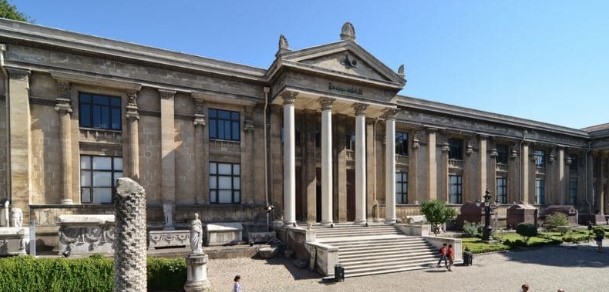
I was at the Sultanahmet entrance of the historic Gülhane Park. The road climbing up right next to it led me first to the Imperial Mint and then to the Archaeology Museum. The mystical, historic atmosphere we felt along the way became even more palpable at the museum entrance. The first thing that caught my attention was that the museum consists of three parts: the Museum of the Ancient Orient on the left and the Tiled Kiosk Museum further ahead. Visitors to the Archaeology Museum also get the chance to see these.
First, the statues in the museum garden caught my eye; I assume they are kept outside because they don’t fit inside. I had visited the museum long ago, and I noticed that the fish pond in the garden had been filled in and statues found in the ancient city of Iasos were now displayed in its place. To be honest, I would have preferred to toss some bread to the fish in the garden instead of seeing the Iasos statues. However, my research showed that these statues were brought here after nearly fifty years of excavation work, with the help of an Italian technical team, and that had they not been brought here, they would have ended up as stones in the wall of the Bebek pier. That changed my mind about the fish pond.

When I walked through the door, a large statue greeted me, almost welcoming me. Continuing to the left, the Osman Hamdi Bey Hall and the room displaying the Royal Necropolis of Sidon stood out, with a room design that reflected the mystery of what it contained. In the middle of the room lay the mummy of Tabnit, King of Sidon. Despite the centuries that have passed, it is only slightly deformed, practically proof of how advanced the art of mummification was at that time. It was so well preserved that you could even make out the internal organs. Among the sarcophagi in the room, the one that impressed me most was the Lycian Sarcophagus. Its carvings of mounted warriors depicted how the person inside had died, and the craftsmanship was superb (see Image 2).

Another room was dedicated to the Royal Necropolis of Sidon. Besides the sarcophagi and other works from that period, the magnificent carving of the Alexander Sarcophagus in its glass case, the scenes it depicts and the detail in them showed just how much importance people attached to death and the afterlife. And of course, there was the Sarcophagus of the Mourning Women. Unlike the others, it did not depict war or how someone died; instead, it was fascinating for its eighteen women shown in different poses of sorrow and weeping. For a moment you wonder: why eighteen, and why eighteen women in different states of mourning? In places like this, you get carried away and start looking for a code or a mystery. According to my research, they are believed to represent the wives and the women of the deceased’s harem, but for some reason I still think there is a mystery and a charm to it (see Image 3).

After seeing the panel describing the sarcophagi inside the museum, I realized I couldn’t write about all of them here. Overall, the museum is extremely rich in sarcophagi. Finally, there is the Sidamara Sarcophagus, found in Konya, whose carving and detail surpass even the first two I described; its reliefs are more than enough to let you live a brief moment from that period.
Other interesting works in the museum are the floor mosaics. The first one I came across was a Roman-era floor mosaic found on Kos. Its colors were still vivid, though not as much as they must have been at the time. Its scenes depicted the animals and nature of the period, reflecting that era like a mirror for anyone curious about it.
Upstairs, the official and other correspondence written for the founding of the archaeology museum was on display. Since I studied Persian, I remember trying to read the first lines of that old document requesting staff for the Tiled Kiosk. Further along the room, the statue of Emperor Hadrian can offer thoughtful visitors a wealth of information, from the clothing of the time to the weather.
A little further on, vessels that I believe date from the Greek period, everyday tools, perfume bottles, hunting tools, water jugs, jewelry and cooking pots showed that, whatever the era, humans never lost their ability to produce and create; on the contrary, in every era they developed technologies suited to the conditions of their time, and their skill in using their minds kept growing. The perfume bottles in particular were the ancient reflection of today’s perfumes. Once again I saw and confirmed that no era was a dark age and no era was superior to another; each had its own beauty. A small miniature of the Trojan Horse brought history to life at the entrance of the children’s room, which is currently closed.
After the Greek and Roman works and the sarcophagi unearthed in other Turkish cities, some pieces of history excavated in Istanbul, brought to light from beneath the land we live on, took us on an exciting journey through what the people who lived here before us did. Sarcophagi recovered from the Golden Horn, Byzantine bone and glass objects, Byzantine mosaics I had never seen before, serpent-head sculptures, water pipes from that period and glassware once again gave me the feeling of living in that era, if only a little. These objects were a clear example of how much importance people then gave to art and how advanced they were in the technologies of their time (see Image 4).

As we reached the end of our visit, the huge six-column entrance of an ancient palace standing in all its splendor just to our left was a unique opportunity to learn about the architecture of that period. I admired its carvings, and I was left with many questions about how such a large and solid structure could be built without today’s construction technology.
As I left the museum, in an area right next to Gülhane Park, probably where the museum’s storage opens to the outside, I saw hundreds of ancient statues lying around unattended, unprotected from the weather, with no indication of which period they belonged to. Seeing these historic statues and artifacts in that state saddened me deeply. I would like to end with these words: history is a heritage that must be passed on to our children.
İstanbul Arkeoloji Müzesi
Tarihi Gülhane Parkı’nın Sultanahmet tarafındaki girişindeydim. Hemen yanından yukarıya doğru uzanan yol beni önce darphaneye sonra da arkeoloji müzesine götürdü. O yolu kat ettiğimizde aldığımız mistik ve tarihi hava, daha müzenin girişinde kendini iyice belirginleştirdi. İlk başta dikkatimi çeken müzenin üç kısım olmasıydı. Solda Eski Şark Eserleri Müzesi ileride ise Çinili Köşk Müzesi olmak üzere Arkeoloji Müzesi’ne gidenler hariçten buraları da ziyaret etme fırsatı bulmaktadırlar.
İlk olarak arkeoloji müzesinin bahçesinde bulunan ve içeriye sığmadığından dışarıda tuttuklarını tahmin ettiğim heykeller dikkatimi çekti. Çok önceden de gittiğim müzenin bahçesinde bulunan balıklı havuz doldurulmuş ve yerlerine İasos antik kentinde bulunan heykellerin sergilendiğini gördüm. Açıkca söylemek gerekirse, İasos heykellerinin yerine bahçede balıklara iki ekmek atmak bana daha hoş gelirdi. Araştırmalarım çerçevesinde elli yılı bulan kazı çalışmaları ve İtalyan teknik heyetinin de katkılarıyla buralara kadar getirilen bu heykellerin ,eğer getirilmeselermiş Bebek İskelesi’ne taş duvar olacaklarını öğrenmek beni balıklı havuzun olması düşüncemden vazgeçirdi.
Kapıdan girdiğimde beni karşılayan ve adeta hoş geldiniz havası veren büyük heykel , sol tarafa doğru devam ettiğimde Osman Hamdi Bey Salonu ve Sidon Kralı Nekropolü’nün sergilendiği yer içerisindekilerin gizemi yansıtan bir oda tasarımıyla dikkatimi çekenlerden oldu. Odanın ortasında bulunan Sayda Kralı Tabnit’in mumyası, üzerinden yüzyıllar geçmesine rağmen çok az deforme olması o zamanın ne kadar ileride bir mumyalama sanatına sahip olduklarının ispatıydı adeta. Hatta öyle güzel mumyalanmıştı ki içerisindeki organları seçebilmek bile mümkündü. Odadaki lahitlerden en çok dikkatimi çeken Likya lahiti adlı lahit oldu üzerindeki atlı savaşçıları temsil eden işlemeler bunun içinde yatan insanın nasıl öldüğünü canlandırıyordu ve işleme sanatı harikuladeydi.(Bkz.Resim2)
Bir diğer oda ise Sidon Kralı Nekropolü odasıydı. İçerisinde içeride bulunan lahitler ve o döneme ait eserlerin haricinde İskender Lahiti’nin cam kabin içerisindeki o müthiş işlemesi anlattığı tasvirler ve tasvirlerdeki detay ölüme ve ölümden sonraki hayata ne kadar önem verdiklerinin ispatıydı adeta. Tabi ki birde ağlayan kadınlar Lahiti vardı. O lahit diğerleri gibi savaş ve nasıl ölündüğünü anlatan bir tasvirle değil de, üzerinde on sekiz tane kadının üzgün ve ağlayan farklı hallerinin tasvirleriyle çok ilgi çekiciydi. Bir an neden on sekiz ve neden on sekiz tane kadının ağlayan farklı halleri diye düşünüyor insan. Böyle yerlerde hep bir şifre ve gizem arıyor kendini kaptırarak ama araştırmalarıma göre ölünün eşlerini ve haremindeki kadınları temsil ettiğine inanılıyor ancak ben hala bir gizem ve bir tılsım olduğunu düşünüyorum nedense.(Bkz.Resim3)
Müzenin içerisinde lahitleri anlatan panoyu gördükten sonra buraya hepsini yazamayacağımı anladım. Genel olarak lahitler bakımından çok zengin bir müze. Son olarak Sidamara Lahdi var ki işleme ve detay bakımından anlattığım ilk iki lahiti geride bırakacak şekilde tasarlanmış Konya’da bulunan bu lahtin üzerindeki işlemeler o dönemden kısa bir anı yaşamanız için yetiyor da artıyor.
Müzede ilgi çekici bir diğer eserler ise taban mozaikleri karşıma çıkan ilk mozaik İstanköy’de bulunan Roma dönemine ait taban mozaik oldu. Üzerindeki renkler hala o dönem kadar olmasa da canlıydı. Üzerindeki işlemeler o dönemin hayvanlarını ve doğasını anlatıyordu o dönemi merak edip acaba diyenler için ayna misali yansıtıyordu.
Üst kata çıktığımızda o zamanın arkeoloji müzesinin kurulması için yazılan resmi yazışmalar ve diğer yazışmalar sergileniyordu. Farsça bölümünde okumam nedeniyle Çinili Köşke kadro isteğinde bulunulan o eski yazının ilk satırlarını okumaya çalıştığımı hatırlıyorum . Odanın ilerisinde bulunan imparator Hadrianusun heykeli düşünen insanlar için giyimlerinden hava durumuna kadar pek çok bilgiyi sağlayabilir.
Biraz daha ileride yunan dönemine ait olduğunu düşündüğüm kaplar, günlük yaşamda kullanılan araç gereçler, koku şişeleri , av araçları, su testileri, takılar ve yemek pişirme kapları hangi dönemde olursa olsun insanın üretme ve bir şeyler yapma yetisini hiç kaybetmediğini aksine her dönemde o dönemin şartlarına uygun teknolojiler geliştirdiğini aklını kullanmaktaki becerisinin ne kadar arttığını gösteriyordu. Özellikle koku şişeleri günümüzün parfümlerinin o dönemdeki yansımasıydı bir kez daha hiçbir dönemin karanlık çağ olmadığını ve hiçbir dönemin diğer dönemden üstün olmadığını gördüm tasdik ettim. Her dönemin kendine has güzellikleri vardı. Truva atının küçük minyatürü şu anda kapalı olan ve çocuklar için hazırlanan odanın hemen girişinde bir tarihi canlandırıyordu.
Yunan eserleri, roma eserleri ve diğer şehirlerimizden çıkarılan lahitlerden sonra İstanbul’dan çıkarılan üzerinde yaşadığımız toprakların altında yatan tarihin gün yüzüne çıkmış bazı parçaları bizden önce burada yaşayan insanların neler yaptığı hakkında heyecanlı bir geziye çıkmamıza neden oldu. Haliç’ten çıkarılmış olan lahitler, Bizans dönemine ait kemik ve cam ürünleri , Bizans dönemine ait daha önceden görmediğim mozaikler, yılanbaşı heykelleri, o dönemin su aktarma boruları ve camdan yapılmış araç gereçler bana biraz olsun o dönemin içinde yaşıyormuş hissi verdi yine. O dönemde kullanılan bu araç gereçlerin ne kadar sanata önem verdiklerinin ve kendi dönemine ait teknolojilerde ne kadar ilerlediklerinin açık bir örneğiydi.(Bkz.Resim4)
Müze gezimizin sonuna gelirken, antik bir sarayın altı sütunlu koca girişinin hemen solumuzda o ihtişamıyla duruşu, o dönemin mimarisi hakkında da bilgi sahibi olmak için bulunmaz bir fırsattı. Üzerindeki işlemelere hayran olduğumu bildirmekle beraber o dönemde şimdiki gibi inşaat teknolojisi bulunmamasına rağmen büyük ve bu sağlam yapının nasıl yapıldığı aklımda bir sürü soru işaretleri bıraktı.
Müzeden ayrılırken Gülhane parkının hemen yanında bulunan bir bölgede tahminen müzenin deposunun dışarıya açıldığı yer olan bölgede yüzlerce antik heykeli orada başıboş ,dış şartlara karşı korumasız ve ne zamana ait oldukları bilinmeyen bu tarihi heykel ve eserlerin o hali beni derinden üzdü. Tarih mirastır, çocuklarımıza bırakılması gereken sözüyle cümlelerimi tamamlamak istiyorum.